





The Shape of a Wool Jacket

Begin with the silhouette
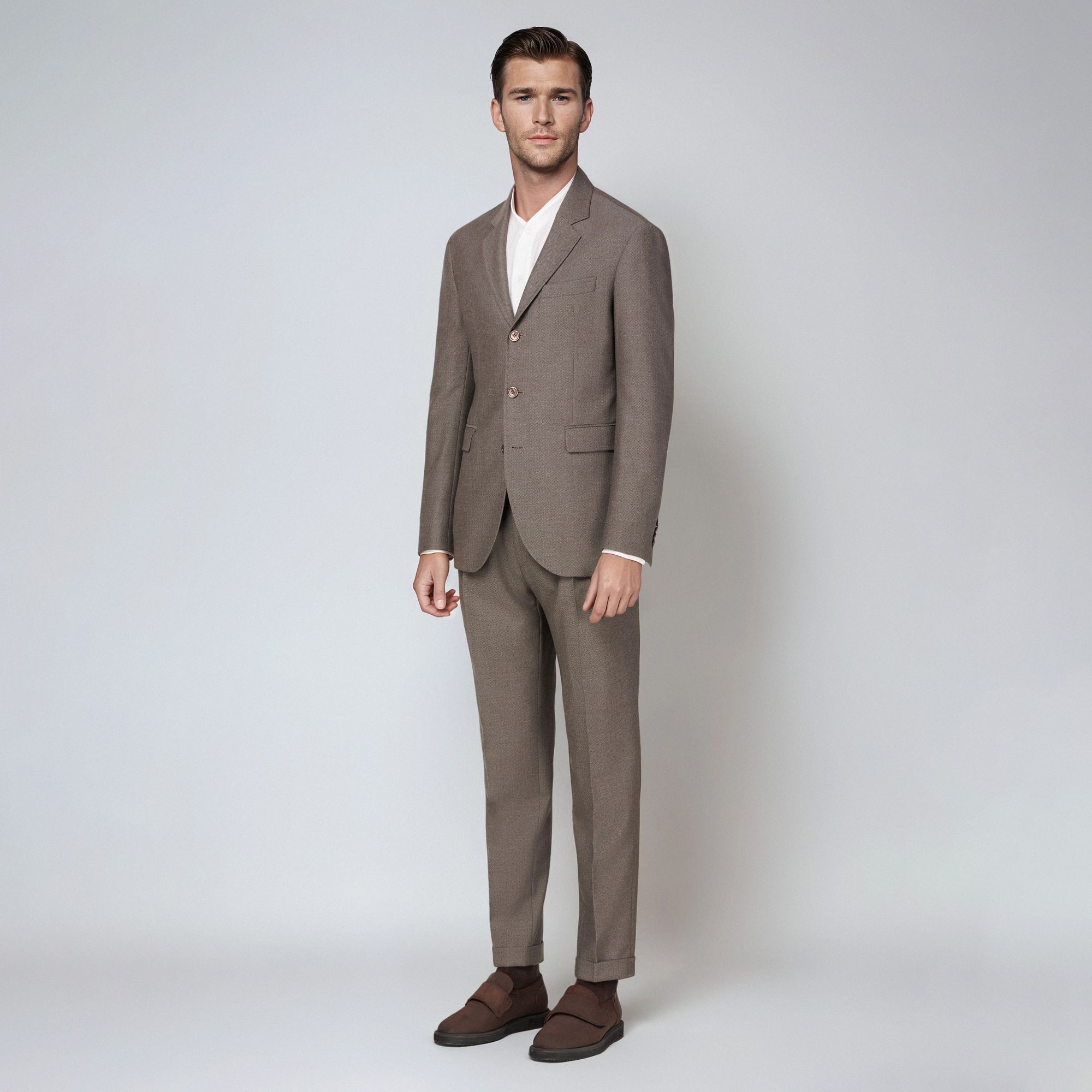
A wool jacket can look straightforward on a hanger. Its character becomes clearer when it is worn: in the line of the shoulder, the position of the waist and the way the cloth falls as the wearer moves. These relationships matter more than any single detail. A shoulder that sits comfortably but appears out of scale with the body changes the whole outline. So does a jacket whose length interrupts the proportions of the trousers beneath it.
The first question is not whether a jacket is fitted or loose. It is whether its shape has a clear intention. Some jackets sit close to the body and give the torso a defined line. Others allow more room through the chest and waist, letting the cloth move more freely. Neither approach is inherently better. What matters is that the shoulder, chest, waist and hem belong to the same silhouette, rather than pulling in different directions.
Length deserves particular attention. A shorter jacket changes the apparent position of the waist and gives the lower half of an outfit more emphasis. A longer one can create a quieter, continuous line. The right balance depends on the wearer's proportions and on the trousers worn with it. Viewed from the side as well as the front, the hem should appear deliberate, not simply long or short by default.
A jacket should also be judged in motion. When the wearer reaches forward or sits down, a little movement in the cloth is natural. Persistent strain across the back, a collar that lifts away from the neck or a front that pulls sharply when fastened may indicate that the cut is not working for that body. Appearance and ease are not separate considerations; each supports the other.
Read the wool, not just the label
Wool describes a fibre, not one fixed appearance or weight. Two wool jackets may feel markedly different because of the yarn, the way the cloth is woven and the finishing applied to its surface. One cloth may have a smooth, compact appearance; another may look softer and more open. These differences affect how a jacket falls, how clearly it holds a line and how it feels against the body.
Weight is useful to notice, but it is not a complete measure of substance. A heavier cloth may give a jacket a more pronounced drape, while a lighter one may allow greater ease. Construction changes the result in either case. The wearer learns more by lifting the jacket, handling the fabric and seeing how it settles after movement than by relying on a weight figure alone.
The surface of the cloth matters visually. Under direct light, a smooth wool can show the contours of a jacket clearly. A more textured surface may soften those contours and give a colour greater depth. Neither needs decorative detail to make an impression. The material is already doing visible work, shaping how the garment meets light and how its silhouette is read from a distance.
Composition should be read precisely. A label stating wool, or a blend containing wool, tells the wearer what fibres are present. It does not, by itself, establish how a jacket was constructed, how it should fit or how long it will last. Those questions call for a closer look at the finished garment and its care instructions. A useful description distinguishes between what is known about the cloth and what can only be judged by wearing it.
Construction should serve the wearer
The structure inside a jacket is less visible than its outer cloth, but its effects can be seen. It helps establish the shoulder, supports the chest and influences the way the front holds its shape. Jackets use different approaches to achieve those effects. The aim is not to find the largest number of construction features; it is to understand whether the finished jacket has the line and ease the wearer wants.
Look first at how the collar meets the neck and how the lapels lie across the chest. With the jacket fastened, the front should settle without conspicuous pulling or an unwanted gap. Open it, and the garment should still retain a coherent shape. A jacket exists in both states during an ordinary day. Judging it only while buttoned and standing still gives an incomplete picture.
The sleeves and armholes affect comfort in ways that are easy to miss during a brief fitting. Raise the arms gently and reach forward as if picking up an object. The whole jacket will move to some extent, but the motion should not feel needlessly restrictive. At the wrist, the sleeve length should make sense with the shirts and knitwear the wearer expects to use beneath it. Small alterations may refine a finished jacket, but they cannot turn an unsuitable underlying cut into the right one.
Inside the garment, lining and finishing deserve a practical look. A lining can affect how readily a jacket slips over other clothing; the extent of lining varies between designs. Seams, pockets and fastenings should feel suited to their purpose. These observations are not a search for hidden prestige. They are a way to understand how the jacket is built and whether its details support everyday use.
Give the jacket a place in the wardrobe
A considered wardrobe does not ask every jacket to do everything. A wool jacket earns its place when its colour, silhouette and degree of formality make sense alongside pieces already worn. This does not require a prescribed outfit. It requires an honest picture of where the jacket will be used and whether its presence feels natural in those settings.
Colour changes the relationship between a jacket and the rest of a wardrobe. Dark wool can create a continuous line with similarly toned trousers, while a lighter or more textured jacket may stand apart more clearly. Neither effect is automatically more useful. Compare the jacket with garments the wearer owns, ideally in daylight, and notice whether the combination feels composed rather than assembled to justify a purchase.
Room for another layer is worth considering before choosing a size. A jacket intended to sit over a fine shirt may not need to accommodate a substantial knit. Conversely, a wearer who regularly adds a layer should try the jacket that way. Sizing up without regard for the shoulder or jacket length can disturb the proportions that made the piece appealing in the first place.
Care is part of the same decision. Follow the garment's own care label, since wool cloths and jacket constructions can differ. After wearing, allow the jacket time to air and recover before returning it to the wardrobe. Use a hanger that supports the shoulders and avoid crowding it between other garments. For marks or cleaning needs, the label and an experienced cleaner offer better guidance than a universal rule.
The most useful test comes after the first impression. Does the jacket remain comfortable as the day goes on? Does its shape still feel right when it is open, seated or worn again with familiar clothes? A wool jacket need not demand attention to justify its place. Its value becomes clearer through proportion, material and repeated use.
Login and Registration Form